|
| | PythonReading (PyObject *pyReading) |
| | Construct a PythonReading from a DICT object returned by Python code. More...
|
| |
| PyObject * | toPython (bool changeKeys=false, bool bytesString=false) |
| | Convert a PythonReading, which is just a Reading, into a PyObject structure that can be passed to embedded Python code. More...
|
| |
|
| Reading (const std::string &asset, Datapoint *value) |
| |
|
| Reading (const std::string &asset, std::vector< Datapoint * > values) |
| |
|
| Reading (const std::string &asset, std::vector< Datapoint * > values, const std::string &ts) |
| |
|
| Reading (const std::string &asset, const std::string &datapoints) |
| |
|
| Reading (const Reading &orig) |
| | Reading copy constructor.
|
| |
|
virtual | ~Reading () |
| | Destructor for Reading class.
|
| |
|
void | addDatapoint (Datapoint *value) |
| | Add another data point to an asset reading.
|
| |
| Datapoint * | removeDatapoint (const std::string &name) |
| | Remove a datapoint from the reading. More...
|
| |
| Datapoint * | getDatapoint (const std::string &name) const |
| | Return a specific data point by name. More...
|
| |
|
std::string | toJSON (bool minimal=false) const |
| | Return the asset reading as a JSON structure encoded in a C++ string.
|
| |
|
std::string | getDatapointsJSON () const |
| | Return the asset reading as a JSON structure encoded in a C++ string.
|
| |
|
const std::string & | getAssetName () const |
| |
|
void | setAssetName (std::string assetName) |
| |
|
unsigned int | getDatapointCount () |
| |
|
void | removeAllDatapoints () |
| | Remove all data points for Reading class.
|
| |
|
const std::vector< Datapoint * > | getReadingData () const |
| |
|
std::vector< Datapoint * > & | getReadingData () |
| |
|
bool | hasId () const |
| |
|
unsigned long | getId () const |
| |
|
unsigned long | getTimestamp () const |
| |
|
unsigned long | getUserTimestamp () const |
| |
|
void | setId (unsigned long id) |
| |
|
void | setTimestamp (unsigned long ts) |
| |
|
void | setTimestamp (struct timeval tm) |
| |
|
void | setTimestamp (const std::string ×tamp) |
| |
|
void | getTimestamp (struct timeval *tm) |
| |
|
void | setUserTimestamp (unsigned long uTs) |
| |
|
void | setUserTimestamp (struct timeval tm) |
| |
|
void | setUserTimestamp (const std::string ×tamp) |
| |
|
void | getUserTimestamp (struct timeval *tm) |
| |
| void | getFormattedDateTimeStr (const time_t *tv_sec, char *date_time, readingTimeFormat dateFormat) const |
| | Convert time since epoch to a formatted m_timestamp DataTime in UTC and use a cache to speed it up. More...
|
| |
| const std::string | getAssetDateTime (readingTimeFormat datetimeFmt=FMT_DEFAULT, bool addMs=true) const |
| | Return a formatted m_timestamp DataTime in UTC. More...
|
| |
| const std::string | getAssetDateUserTime (readingTimeFormat datetimeFmt=FMT_DEFAULT, bool addMs=true) const |
| | Return a formatted m_userTimestamp DataTime in UTC. More...
|
| |
| std::string | substitute (const std::string &str) |
| | Substitute values from this reading into the string. More...
|
| |
|
| enum | dateTimeFormat { FMT_DEFAULT,
FMT_STANDARD,
FMT_ISO8601,
FMT_ISO8601MS
} |
| |
|
typedef enum Reading::dateTimeFormat | readingTimeFormat |
| |
|
Reading & | operator= (Reading const &) |
| |
| void | stringToTimestamp (const std::string ×tamp, struct timeval *ts) |
| | Convert a string timestamp, with milliseconds to a struct timeval. More...
|
| |
| const std::string | escape (const std::string &str) const |
| | Escape quotes etc to allow the string to be a property value within a JSON document. More...
|
| |
| std::vector< Datapoint * > * | JSONtoDatapoints (const rapidjson::Value &json) |
| | Convert a JSON Value object to a set of data points. More...
|
| |
|
unsigned long | m_id |
| |
|
bool | m_has_id |
| |
|
std::string | m_asset |
| |
|
struct timeval | m_timestamp |
| |
|
struct timeval | m_userTimestamp |
| |
|
std::vector< Datapoint * > | m_values |
| |
| static std::vector< std::string > | m_dateTypes |
| |
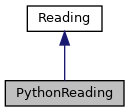
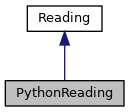
A wrapper class for a Reading to convert to and from Python objects.

 Public Member Functions inherited from Reading
 1.8.17